Ankle Stability Training Enhances Movement Foundation
Introduction: The Hidden Weakness Undermining Your Fitness
Most people walk into a gym thinking about their core, their glutes, or their upper body. Nobody thinks about their ankles until one gives out on them. Ankle stability training is one of the most overlooked components of a solid fitness program, and in my experience, that oversight is responsible for more setbacks than almost anything else I see.
Your Ankles Are Your Movement Foundation
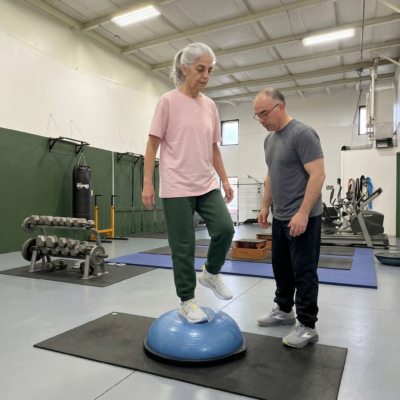
A client of mine, a retired executive in her early sixties, came to me after her second ankle sprain in three years. Both happened during ordinary situations: once stepping off a curb, once hiking a mild trail near the Monon. She was in good shape overall, but her ankles had never been trained to handle anything unpredictable. That is exactly the gap ankle stability training fills.
Why Your Ankles Deserve More Attention
The ankle is not a simple hinge joint. It operates across multiple planes of motion, absorbs force with every step, and feeds constant information to your nervous system about where your body is in space. That last function — called proprioception — is what keeps you from rolling your ankle every time you step on an uneven surface.
Research from the Journal of Athletic Training estimates that ankle sprains account for nearly 40% of all sports-related injuries, with approximately 25,000 occurring daily in the United States. More concerning is what happens after: people who sprain an ankle are five times more likely to do it again. That cycle almost always comes down to untrained stability and poor proprioceptive recovery, not bad luck.
When the ankle stabilizers are weak or under-trained, other joints compensate. Your knee starts absorbing forces it was not designed to handle. Your hip adjusts. Your lower back picks up the slack. What started as an ankle problem quietly becomes a knee problem, or a hip problem, and most people never connect the two.
What Ankle Stability Training Actually Is
Ankle stability training is not just standing on one foot and hoping for the best. It is a systematic approach to strengthening the muscles around the joint, restoring proprioceptive feedback, and training the nervous system to react quickly when the ankle is challenged.
The peroneal muscles, running along the outer lower leg, are the primary defenders against inversion sprains — the kind where the foot rolls outward. Studies show that people with a history of ankle instability have measurably slower peroneal reaction times, sometimes by 50 milliseconds or more. That fraction of a second is the difference between catching yourself and twisting your ankle. Targeted training closes that gap.
The intrinsic muscles of the foot — the small muscles entirely within the foot itself — act like the core of your foundation. Most people have never trained them deliberately. Exercises like short foot holds, toe spreads, and single-leg balance work recruit these muscles directly and build the stable platform your larger leg muscles need to do their jobs.
How Ankle Stability Training Progresses
Effective training follows a clear progression. Rushing this process is one of the most common mistakes I see, and it produces poor results or, worse, new injuries.
Stage one focuses on building basic strength and proprioception on stable surfaces. Single-leg stance, ankle circles through full range of motion, and resistance band work in all four directions — plantarflexion, dorsiflexion, inversion, eversion — form the foundation. These are not glamorous exercises, but they are essential. Many people discover significant differences between their right and left ankles during this phase.
Stage two introduces controlled instability. Balance pads, wobble boards, and exercises performed with eyes closed challenge the neuromuscular system to work harder. Research in the Journal of Strength and Conditioning Research confirms that unstable surface training produces greater muscle activation in the ankle stabilizers than stable-surface work alone. The key word is “controlled” — you should be managing the challenge, not fighting to survive it.
Stage three brings dynamic, reactive movements: single-leg hops, lateral bounds, controlled landings, and sport-specific drills. A study in the American Journal of Sports Medicine found that athletes who performed dynamic stability training reduced lateral ankle sprain risk by 47% compared to those who only did static balance work. This phase prepares the ankle for real-world conditions, where surfaces change and direction changes happen without warning.
How This Connects to the Activities You Love
For golfers, ankle stability matters during the rotational demands of the swing and when navigating uneven terrain between holes. For runners on the Monon Trail, it matters when a root or a crack in the pavement appears without warning. For anyone who plays pickleball, tennis, or basketball, it matters every time you change direction.
A dear friend who trains with me — an avid golfer in his fifties — noticed his ball striking became more consistent after we spent six weeks focusing on his ankle and hip stability together. His base was unstable, and it was costing him power and accuracy without him realizing it. Once his foundation improved, everything built on top of it improved too.
This is what a good personal trainer looks for: not just the obvious weakness, but the foundational one that is creating problems upstream. Ankle stability is almost always part of that picture.
Try This: The Short Foot Exercise
This is the single best exercise for activating the intrinsic foot muscles, and almost no one does it.
Stand barefoot with your foot flat on the floor. Without curling your toes, try to shorten the distance between your heel and the ball of your foot by doming the arch slightly. Hold for 5 seconds. Release fully. Repeat 10 times per foot.
It sounds simple, and it is. But the first time most people try it, they cannot do it correctly. Their toes curl, their leg tenses, or nothing happens at all. That disconnect is the problem ankle stability training solves. Once you can do this consistently, progress to performing it while standing on one leg.
Aim for two to three sessions per week. Pair it with single-leg balance work for 30 to 60 seconds per side, and resistance band ankle work in all four directions for 15 repetitions each. You can do all of this in under 10 minutes, and the compounding benefit over weeks and months is substantial.
Common Mistakes That Slow Your Progress
The biggest mistake is skipping the foundation and going straight to wobble boards or advanced balance drills. If the basic muscles are not strong enough, unstable surfaces reinforce poor movement patterns instead of correcting them.
The second mistake is training only in one plane of motion. Most people do calf raises and call it ankle work. The ankle must be trained in all directions — inversion, eversion, dorsiflexion, and plantarflexion — to build complete stability.
The third is inconsistency. Neuromuscular adaptations begin fading within two to four weeks without training. This is not a program you do for six weeks and forget. It becomes a permanent part of your warm-up or general training routine, taking very little time once it is established.
Building From the Ground Up
The benefits of strong, stable ankles extend well beyond injury prevention. Improved ankle stability enhances efficiency in movement, reduces energy expenditure, and builds the kind of confidence in your body that lets you stay active without constant worry about the next setback.
For adults in Carmel, Indiana, where an active lifestyle is part of the culture, this work is an investment that pays dividends across decades. Whether you are hiking, golfing, playing with grandchildren, or simply walking without thinking about where your feet land, ankle stability is what makes that freedom possible.
At Mobility360.fit, this is the kind of foundational work we prioritize with every client. If you are not sure where your ankles stand, that is a great place to start the conversation. Working with a personal trainer who can assess your movement and build a program around your specific needs is the most efficient path forward — and the most effective one.