Wrist Strength Training Prevents Overuse Injuries
Most people never think about their wrists until something goes wrong. Wrist strength training prevents overuse injuries by developing the muscles, tendons, and connective tissue that your hands and forearms depend on every single day. Whether you are swinging a golf club at Purgatory Golf Club, picking up your grandchildren, or simply typing through a long workday, your wrists are working harder than you realize, and most fitness programs ignore them almost completely.
The Hidden Cost of Neglecting Your Wrists
The wrist is not a single joint. It is a remarkably complex architecture of eight small carpal bones, dozens of tendons crossing from the forearm, and a web of ligaments holding all of it together under load. That complexity is what gives your hands their extraordinary range of motion, but it also means there are many places where things can quietly go wrong.
Overuse injuries of the wrist and forearm are among the most common complaints in active adults between 35 and 65. Carpal tunnel syndrome, De Quervain’s tenosynovitis, and lateral epicondylalgia (better known as tennis elbow) share a familiar root cause: repetitive stress applied to tissues that lack the strength to absorb it. Research published in the Journal of Orthopaedic and Sports Physical Therapy confirms that targeted strengthening significantly reduces the recurrence rate of these conditions. The goal of wrist strength training is not to build impressive forearms. It is to give those tissues enough capacity to handle the demands you place on them, day after day, without breaking down.
Why Imbalance Is the Real Problem
The forearm contains two distinct groups of muscles that control wrist movement. The flexor compartment, running along the palm side of the forearm, handles gripping and bending the wrist downward. The extensor compartment, on the back of the forearm, lifts the wrist and fingers upward. In most adults, these two groups are significantly out of balance.
Desk workers, golfers, cyclists, and pickleball players all share the same pattern: their flexors are chronically tight and overworked while their extensors remain weak and underused. This imbalance shifts how force travels across the joint. When one side does all the work, the tendons and ligaments on the other side compensate, absorbing loads they were not designed to manage. Over weeks and months, that mismatch creates micro-damage faster than the tissue can recover, and eventually, pain arrives.
A dear friend who trains with me had been dealing with nagging elbow pain for two years before we started addressing her wrist extensors directly. She had attributed the problem to a heavy training schedule, and she was partially right. But the real issue was that her flexors were dramatically stronger than her extensors, pulling the entire elbow into a position of constant strain. Within eight weeks of balanced wrist training, the discomfort she had accepted as permanent was essentially gone.
Understanding the Muscles Behind Wrist Strength Training
Effective wrist strength training does not mean squeezing a stress ball. It means addressing all the relevant muscle groups in a deliberate, progressive sequence.
The Flexors and Extensors
The flexor carpi radialis and flexor carpi ulnaris control wrist flexion and are heavily engaged any time you grip something. The extensor carpi radialis longus and brevis, along with the extensor carpi ulnaris, manage wrist extension and are central to racquet sports, golf follow-through, and any overhead lifting. Strengthening both sides of this relationship, with roughly equal attention, is the foundation of overuse injury prevention.
The Rotators
The pronator teres and supinator muscles govern forearm rotation, the motion involved in turning a doorknob, using a screwdriver, or serving in tennis. These muscles are frequently underdeveloped and are a primary contributor to elbow pain when they cannot handle the rotational loads demanded by sport or daily activity.
The Intrinsic Hand Muscles
The thenar and hypothenar muscle groups, located in the palm itself, provide fine motor control and meaningful grip endurance. Strengthening these muscles improves the stability of every grip-dependent movement, from deadlifts to carrying groceries. A skilled personal trainer will assess all of these groups as part of a wrist evaluation rather than simply testing grip strength with a dynamometer and calling it done.
Wrist Demands Specific to Active Carmel Adults
The activities most popular in Carmel, Indiana place very specific demands on the wrist that generic fitness programs rarely address. Golfers need strong wrist extensors and a stable, controlled release through impact. Weakness in the extensors is a primary driver of medial epicondylalgia, the condition known as golfer’s elbow, which is far more common among recreational golfers than most people realize. Pickleball players generate considerable wrist snap during dinking and driving, making balanced flexor-extensor strength essential for anyone planning to play regularly into their 60s and 70s. Cyclists who log long rides along the Monon Trail grip their handlebars in sustained isometric loading for extended periods, placing significant demand on wrist stabilizers that rarely receive any direct training.
The point is that wrist strength training does not look identical for every person. A good personal trainer will design a program based on the activities you actually do, not a generic protocol copied from a textbook. That specificity is what separates effective prevention from wasted effort.
How Wrist Weakness Affects Everything Above It
Here is something most people do not consider: a weak, unstable wrist changes how your elbow and shoulder absorb force during exercise. When the wrist cannot maintain a stable position under load, the body compensates by shifting that load upward through the kinetic chain. This compensation is largely unconscious, which makes it dangerous. The result is often shoulder impingement or persistent elbow pain in someone who has no identifiable wrist complaint and no idea their wrists are the source of the problem.
Over the years, I have seen this pattern more times than I can count. Someone comes in with shoulder pain during pressing movements, and after a proper assessment, the root cause traces back to wrist instability that forces the elbow into a slightly altered tracking position with every repetition. Addressing the wrist resolves the shoulder. Wrist strength training protects multiple joints simultaneously, which is one of the best arguments for treating it as a standard component of any upper body program rather than an afterthought.
Evidence-Based Training Methods That Actually Work
A systematic review published in the British Journal of Sports Medicine found that eccentric and isometric wrist exercises were among the most effective interventions for both treating and preventing lateral epicondylalgia. For healthy adults focused on prevention, a balanced protocol combining wrist flexion and extension curls, radial and ulnar deviation exercises, forearm pronation and supination with resistance, and grip endurance training provides comprehensive tissue adaptation across all the relevant structures.
Equipment selection matters. Light dumbbells in the 1 to 5 pound range are appropriate for most wrist isolation exercises. Resistance bands allow smooth, joint-friendly loading through the full range of wrist motion and are particularly well-suited to rotational movements. Plate pinches and towel hangs develop intrinsic hand strength that translates directly to sport and everyday life. The American College of Sports Medicine recommends progressing wrist-specific exercises from two to three sets of 15 to 20 repetitions at light resistance, advancing load only after movement quality is firmly established.
One critical point about progression timelines: tendons and ligaments adapt more slowly than muscle. Most people notice meaningful strength improvements within six to eight weeks, but genuine tendon adaptation requires 12 to 16 weeks of consistent training. Rushing load increases is a primary reason wrist training programs produce injury rather than preventing it. Forty-eight hours of recovery between sessions is the minimum, and any sharp or persistent pain during training is a clear signal to reduce load and consult a professional before continuing.
Try This: The Wrist Four-Way
This simple routine takes under 10 minutes and can be done at home with a single light dumbbell (1 to 3 pounds).
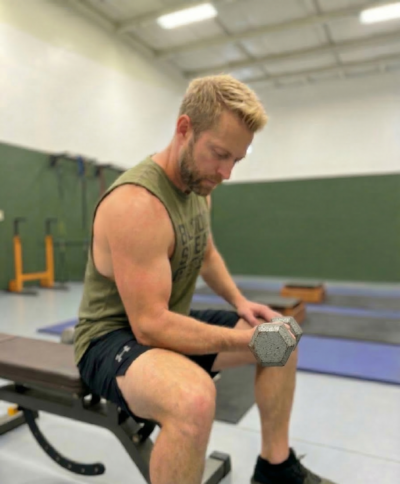
Sit at the edge of a chair and rest your forearm on your thigh with your hand hanging off your knee, palm facing up. Perform 15 slow wrist curls (flexion), then flip your forearm so the palm faces down and perform 15 wrist extensions. Next, hold the dumbbell vertically like a hammer and perform 15 radial deviations (tilting the thumb side of your wrist upward), then 15 ulnar deviations (tilting the pinky side upward). Complete two rounds on each arm, resting 30 to 45 seconds between sets. Do this three times per week, and after eight weeks, increase to a 2 to 3 pound dumbbell. The motion should feel controlled throughout. If it hurts at any point, use a lighter weight or no weight at all until the movement becomes comfortable.
Building Wrist Resilience for the Long Term
Wrist strength training prevents overuse injuries not through a single dramatic intervention but through the steady, patient accumulation of tissue resilience built session by session. For the active professional in Carmel, Indiana who wants to keep playing golf, enjoying pickleball, and performing well without the constant interruption of nagging wrist or elbow pain, this training represents one of the highest-value investments in your physical health. The wrists are foundational to nearly every upper body activity you perform. Give them the attention they have quietly deserved all along. If you are ready to build a program specifically designed around your body and your activities, reach out at Mobility360.fit. This is exactly the kind of work we do best.