A PROFESSIONAL POSTURE
Software developers, bus drivers, accountants, insurance agents, human resource managers, and attorneys have one thing in common: they sit for extended periods. According to The United States Department of Labor, those professionals are the ones that sit for the longest time.
Office jobs have become a way of making a living for many people around the world. Unfortunately, sitting for long periods can have a negative impact on body posture.
Many professionals incorporate regular physical training into their routine, which helps to diminish or counter the effects of long sitting times.
Nowadays, sitting is optional for many office workers, as many companies offer the option of standing desks.
THE POSTURE GIVES IT AWAY
With the popularity of compact entertainment devices (smartphones), people-watching is a much less common practice. Anyways, some people still entertain themselves looking at people passing by. Body posture says a lot about people’s lifestyles, people like football or basketball players stand out easily, but office-warriors are commonly overlooked, at least until now.
Look at these two versions of David. One of them worked as a shepherd and eventually killed a giant with a sling and a stone, while the other one worked for the last 15 years behind a desk. Could you spot who is who?

Sitting for extended periods forces the body into an Anterior Pelvic Tilt (APT), stretching the lower back muscles, and tightening the hamstrings and hip flexors. Someone with the APT syndrome will stand with a “flat back”.
The curvature of the spine among quadrupeds is much milder than it is on bipeds. The iconic “S” shape of our spine balances perfectly our body, creating even pressure on the discs and allowing a wide range of motions. The normal curvature of the lumbar area is between 39 and 53 degrees. Beyond those limits, the pressure on the discs starts being uneven and has the potential of causing injuries.
ANALYZING THE TWO DAVIDS
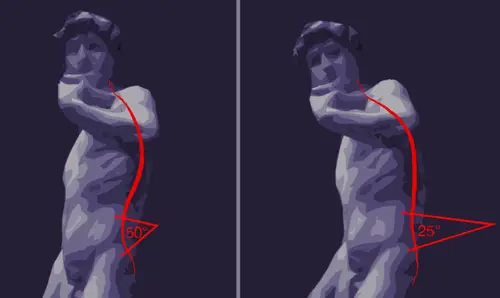
The lumbar spine of David on the left rests at approximately 50º, which is within the normal range. The lumbar spine of the modified David rests at 25º, which is much below the normal range. Consequently, that implies the David on the right is forcing an uneven pressure of the discs, causing severe discomfort or pain. With time, such pressure can cause high damage to the disc, like herniations.
As much as it is impossible to be 100% certain of the reason for the posture of David on the right (besides the obvious photoshop intervention), we could safely assume a few factors:
THE MUSCULAR DISBALANCE
1- The muscles of the lower back, commonly known as “erector spinae” are not strong enough to tilt the pelvis at a normal angle.
2- The hamstrings, lower abdominals, and hip flexors are tight enough to overpower the strength of the lower back, forcing the hips into the forward-tilted posture.
THE FLEXIBILITY TEST
1- The tightness of the hip flexors would make performing a split squat at the full range of motion virtually impossible for David.
2- The lack of hamstring mobility would prevent David from being able to raise the leg straight forward at 90º, without rounding the back.
THE TILT TEST
If David stood in a neutral position and tried to tilt his hips backward, he would be able to do it. But if David went back to the neutral position and tried to tilt the hips forward, he would find out that he cannot. The reason is that the hips are already tilted forward in what is supposed to be a neutral position.
In a balanced individual, the neutral position should be at some intermediate point between the maximum anterior and posterior tilt point.
FEW WORDS ABOUT THE SPINE
The spine is such an intricate and magnificent piece that it is the center of millions of books. The cadence and rhythm in which each vertebra connects and transitions into the next could be the inspiration for many art masterpieces. With the fear of falling short, I will try my best on explaining how the vertebras of the lumbar spine interact between them as well as with the discs.
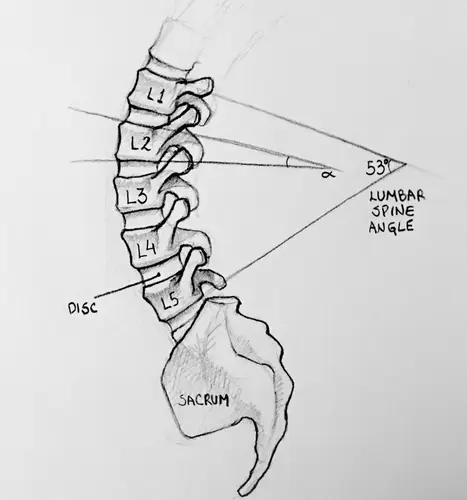
The angle of the lumbar spine is measured from the top of L1 to the bottom of L5. Any angle above 53º or below 39º will apply uneven pressure on the disc, leading to serious issues.
The lumbar spine is formed by the 5 vertebras above the sacrum. Each vertebra is a transitional design between the one above and below, which allows a combination of mobility, stabilization, and protection to the spinal cord (not in the image). Each one has a characteristic angle (marked α in the drawing) that allows distributing the force (weight) evenly on the disc below it.
THE RECOMMENDATION
Earning a living is not optional or negotiable. Many people work desk jobs in the USA, and consequently, they sit for extended periods.
There are some stretches office workers can perform without leaving their job-place. Also, there are motions and exercises that will help to counter the negative effects from sitting during long periods, that help to stretch the muscles that tilt the hips forward and strengthen the muscles responsible for tilting the hip backward.
THE RESEMBLANCE TO MODERN DAY ADS
There is something deeply misleading about Michelangelo’s David. He labored his younger years as a shepherd, walking miles and miles with a herd of sheep, which would explain for him to be lean, but doesn’t explain the strong shoulders, chiseled midsection or sculpted legs (no pun intended).
Modern fitness ads frequently feature well-built individuals crediting devices as the Jump-Snap or the ThightMaster for their physique.
A little piece of advice: do not buy a herd to sheep and expect to look like David.
DAVID AND GOLIATH
Possibly the most famous fight in history (and wasn’t broadcasted in PPV). A colossal battle that is often misinterpreted.
David, the young and smaller shepherd, was designated to confront the giant gladiator with vast combat experience. Commonly, people look at David as the ultimate underdog, but was he really?
Goliath brought to the fight his size and overwhelming strength as well as the weaponry that gave him many victories (in close-range fights). David brought nothing but a sling and some stones, useless for close-range encounters, but the perfect choice for the long-range.
Goliath literally brought a stick to a stone battle, and the outcome is well known.
The moral of the story is that David didn’t win the battle by being stronger or more skilled. He won by being smart and able to think out of the box, which gave no chance to an opponent that seemed unbeatable.
Often, we forget to think out of the box to find a solution to apparently impossible situations we must deal with.