Loaded Step Training Builds Functional Leg Power
A simple step sits in the corner of my studio, and almost every new client walks right past it. They assume it is a warm-up prop, something for beginners before the “real” training starts. Twenty years of working with professionals here in Carmel, Indiana have taught me otherwise. Loaded step training, the practice of performing weighted movements onto or off an elevated surface, is one of the most effective tools for building functional leg power that actually transfers to daily life. Climbing stairs with groceries in your hands, stepping confidently off a curb, recovering from an unexpected stumble: all of these demand the same kind of single-leg strength and coordination that a loaded step develops better than almost any other exercise. I have seen how the confidence of a person changes whenever they can perform the step-ups without any concern about their balance.
Why a Step Is Smarter Than a Squat Rack
People love bilateral exercises. Squats, leg presses, deadlifts: they feel productive, they load up heavy, and the numbers go up reliably. The problem is that life does not happen with both feet planted symmetrically on flat ground. Every stride you take, every staircase you climb, every time you push out of a car seat, you are relying on one leg to produce force while the other manages the transition. Bilateral exercises let your stronger side quietly compensate for your weaker one, and that imbalance grows silently over time until a knee starts aching or a hip tightens unexpectedly.
Research published in the Journal of Strength and Conditioning Research confirms that unilateral lower-body exercises produce significantly greater muscle activation in the glutes and stabilizing muscles compared to traditional bilateral lifts performed at equivalent loads. Loaded step training takes that advantage further by adding an elevated surface, which extends the range of motion and forces your working leg to control both the ascent and the descent through a longer arc. The result is a training stimulus that builds functional leg power in the muscles your body actually needs to move safely and confidently for decades.
Step Height Changes Everything
One of the most important decisions in loaded step training is choosing the right step height, and it is a detail that many people overlook entirely. A 12-inch step is not a “beginner step” any more than a light dumbbell is a beginner weight: it is a specific tool that trains specific qualities. At that height, the movement is quad-dominant, the balance demands are manageable, and the range of motion allows most people to maintain good technique even under load. It is the ideal starting point for building the neuromuscular foundation that makes higher-step training safe.
A 24-inch step changes the equation dramatically. The increased range of motion shifts greater demand onto the glutes and hamstrings, challenges hip mobility in a meaningful way, and significantly raises the balance and coordination requirements. At this height, technique errors that were minor at 12 inches become conspicuous, and adding external load on top of poor mechanics is a reliable path to injury. Stackable steps give you a built-in progression system: master 12 inches, then earn your way to 24. A good personal trainer uses step height as a diagnostic tool, watching how your body organizes itself at each level before deciding what comes next.
The Core Movements of Loaded Step Training
Weighted Step-Ups: The Foundation
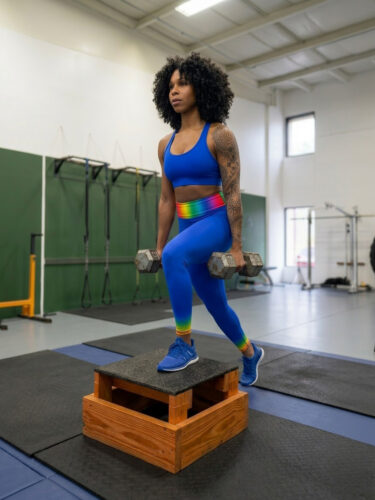
The weighted step-up is where loaded step training begins. Stand facing your step, hold a dumbbell in each hand, and place your working foot fully on the surface, not just the ball of the foot. Drive through your heel to lift your body up, bring your trailing foot to meet the working foot at the top, and then lower yourself with deliberate control. The single most common mistake is pushing off the trailing foot at the bottom of the rep, which reduces the demand on the working leg and defeats the purpose of the exercise. All the power comes from the foot that is on the step. At 12 inches, this feels accessible for most healthy adults. At 24 inches with dumbbells in hand, it is genuinely demanding for anyone.
A client of mine, a civil engineer in his early 50s who had been active his whole life, was humbled the first time he tried step-ups at 24 inches with 25-pound dumbbells. He had been squatting and deadlifting for years, but the unilateral demand exposed a meaningful left-side weakness that neither of us had suspected. Within eight weeks of dedicated step work, that imbalance had largely corrected itself, and his chronic left knee discomfort disappeared along with it.
Lateral Step-Ups: Hip Stability You Cannot Ignore
Standing beside your step and stepping up sideways looks simple and trains something critically important. This variation targets the hip abductors and external rotators, the muscles responsible for keeping your knee tracking over your toes rather than caving inward under load. Weakness in these muscles is one of the most consistent contributors to knee pain in adults over 40, particularly during activities like running along the Monon Trail, playing weekend golf, or picking up a recreational pickleball habit. Adding light dumbbells to lateral step-ups builds the hip stability that protects your knees in every direction life throws at them.
Deficit Reverse Lunges: Length Where You Need It Most
Place your working foot on the step and step the other foot back into a reverse lunge. The elevation creates a deeper range of motion than a floor-level lunge, loading the quad and hip flexor through a longer stretch. This is particularly valuable for people who spend the bulk of their working hours seated, which describes the majority of the professionals I train. Prolonged sitting shortens the hip flexors and shuts down the glutes, and the deficit reverse lunge works against both tendencies in a single movement. Light dumbbells are all you need to make this exercise genuinely challenging.
How Functional Leg Power Translates to Real Life
Functional leg power is not a gym metric. Nobody outside a training facility cares how much weight you can move on a leg press. What matters is how your legs perform when daily life demands it: whether you can climb a long staircase without your thighs burning by the third floor, whether you can step up onto a curb without thinking about it, whether you can recover your balance quickly when you misstep on an uneven surface. These are the qualities that determine your independence and confidence of movement as you age, and loaded step training addresses them more directly than almost any conventional exercise.
The American College of Sports Medicine has noted that muscular power, the ability to generate force quickly, declines at roughly twice the rate of strength after age 40. This is why people can still lift heavy things but feel slow or uncertain in dynamic movements. Loaded step training, performed with intention on the concentric phase (drive up with force) and control on the eccentric phase (lower slowly), trains both power and strength simultaneously. This combination is what makes the difference between someone who moves with confidence and someone who has quietly started avoiding stairs.
Technical Details That Determine Your Results
Loaded step training is not technically complicated, but the details matter. Your entire foot must be on the step surface, heel included, to ensure that the force transfers correctly through your glute and not through your lower back. Your knee should track directly over your second and third toes throughout the movement. A knee that drifts inward is a signal of hip weakness that should be addressed before adding more load. Your torso should remain upright with only a slight forward lean; excessive forward lean is your body’s way of recruiting the lower back when the legs are not strong enough to handle the demand.
Load selection deserves the same attention as step height. Eight to twelve controlled repetitions with perfect form is the target range. If your form breaks down in the final reps, reduce the weight before you think about raising the step. These two variables, load and height, should be progressed independently and never simultaneously. Changing both at once removes your ability to understand what is driving any change in performance or discomfort. A personal trainer can assess these movement details from angles that are impossible to monitor on your own, catching compensations early before they become habits.
Try This: The 4-Week Loaded Step Starter Protocol
This four-week plan builds the foundation for loaded step training safely and effectively.
Weeks 1 and 2 (12-inch step, bodyweight only): Perform 3 sets of 10 reps per leg of standard step-ups and lateral step-ups. Focus entirely on driving through the heel and not pushing off the trailing foot. Rest 60 seconds between sets. Do this twice per week.
Weeks 3 and 4 (12-inch step, light dumbbells): Add dumbbells that allow you to complete all reps with clean form. A pair of 10s to 15s is a reasonable starting point for most people. Introduce 2 sets of 8 deficit reverse lunges per leg with the same light load. Three sessions per week if recovery allows, two if it does not.
At the end of four weeks, assess whether your knee tracks cleanly, whether your form holds through the final rep of each set, and whether the movement feels natural rather than effortful. If the answer to all three is yes, you are ready to progress to heavier dumbbells or a taller step, one variable at a time.
Building Leg Power That Lasts
The value of loaded step training lies in its honesty. It shows you exactly where your legs are strong and exactly where they are not, and it gives you a clear, structured path to address both. A pair of stackable steps and two dumbbells can carry a dedicated adult’s leg training further than most people expect, building the functional leg power that shows up in every flight of stairs, every outdoor adventure, and every confident stride through daily life.
At Mobility360.fit in Carmel, Indiana, this kind of training is at the core of what I do with every client who walks through the door. The goal is never to impress anyone in a gym. It is to make sure your legs are strong enough, stable enough, and coordinated enough to support the life you want to live, for as long as you want to live it. If you are ready to build that kind of strength, this is a good place to start.