<PART I: THE BONES PART III: IN SPORT AND FITNESS
THE AMAZING SHOULDER
PART II: THE MUSCLES
The muscles bring the action, but not every muscle brings the power, in fact, most of them assist with the stabilization or by accomodating the scapula in the correct position to allow the arm to exert mighty movements at specific angles. Making an analogy, we have the deep muscles drive, while the external muscles and the muscles of the arm bring the power.
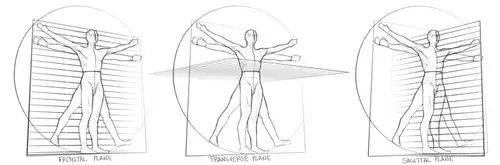
Some literature explains the movement of the body in relationship to the planes. For reference, it’s recommended to utilize the following graphic.
DEEP MUSCLES
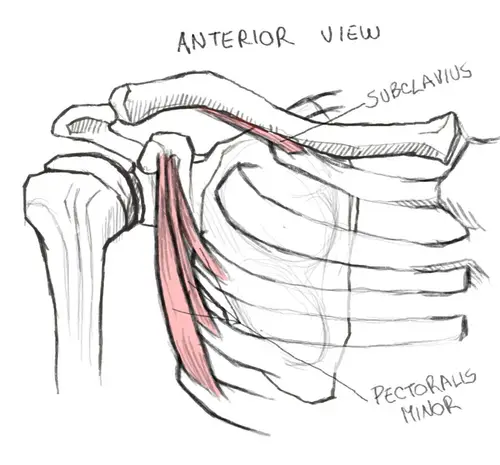
PECTORALIS MINOR & SUBCLAVIUS
The Pectoralis Minor attaches to ribs III, IV, and V; and draws the scapula forward and downward.
The Subclavius suppresses the clavicle and draws the shoulder forward.
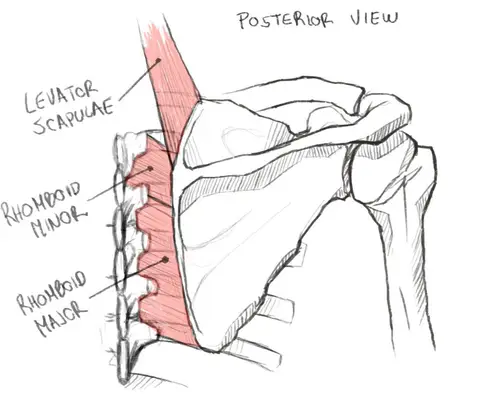
RHOMBOIDS AND LEVATOR SCAPULAE
The Rhomboids retract and elevate the scapula, while the Levator Scapulae function is to merely elevate the scapula.
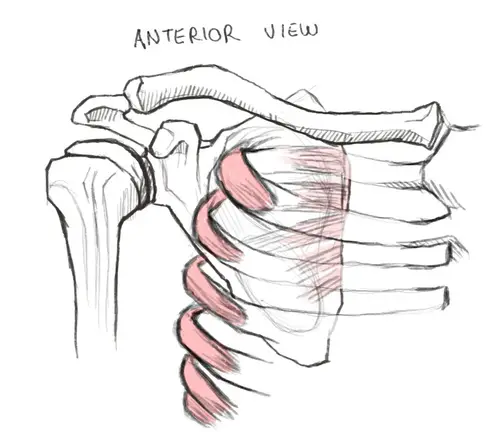
SERRATUS ANTERIOR
The Serratus anterior connects the medial border of the scapula and the ribs. Rotates and pull the scapula forward.
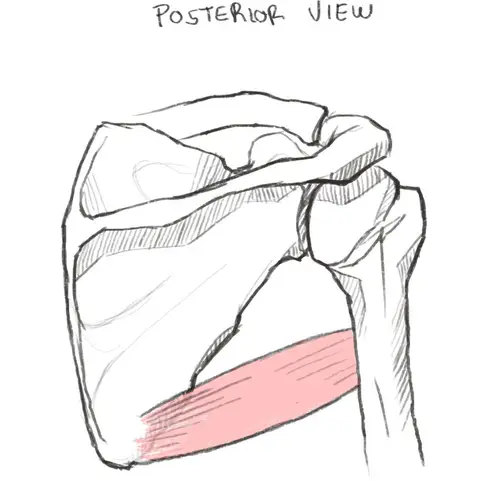
TERES MAJOR
The Teres Major assists with the adduction of the arm and rotates the arm inward.
ROTATOR CUFF
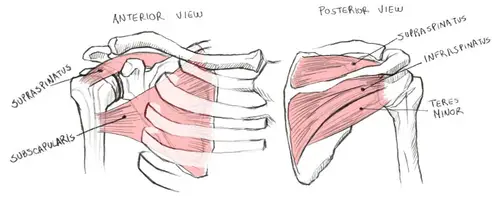
The infamous “rotator cuff” is a group of four muscles that attach directly from different points of the scapula to the humerus, bringing stability to the joint. Also know by their acronym SSIT, the Rotator cuff is conformed by the Subscapularis, Supraspinatus, Infraspinatus, and Teres Minor.
SUBSCAPULARIS
The Subscapularis rotates the arm inward and stabilizes the glenohumeral joint.
SUPRAESPINATUS
Draws the humerus toward the glenoid fossa (stabilizing the joint), and assists the deltoid in raising the arm.
INFRASPINATUS
Draws the humerus toward the glenoid fossa and rotates the arms outwards.
TERES MINOR
Assists with the adduction of the arm.
SUPERFICIAL MUSCLES
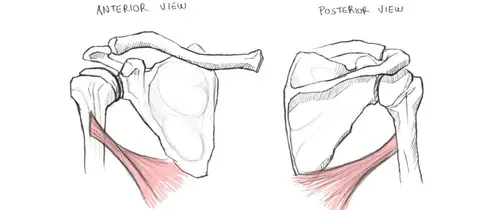
LATISSIMUS DORSI
The Latissimus Dorsi pulls, adducts, and rotates the arm inwards. It also draws the shoulder downward and backward and keeps the lower angle of the scapula against the ribs.
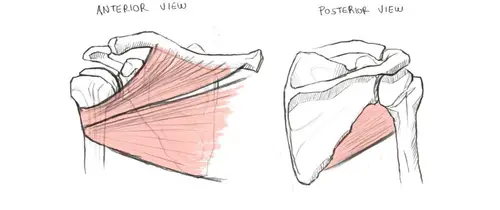
PECTORALIS MAJOR
The Pectoralis Major moves the arm forward and rotates the arm inward.
TRAPEZIUS
The trapezius muscle is a powerful elevator of the shoulder; also rotates the scapula outwards to extend the reach of the arm.
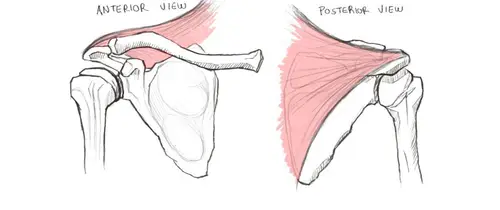
DELTOID
The Deltoid is the largest, strongest muscle of the shoulder. It originates in three portions, the anterior, middle, and posterior portions: The anterior portion arises from the clavicle. The middle portion from the acromion process and the posterior portion from the lower border of the spine of the scapula.
The anterior portion moves the arm forward and rotates the arm inward, the middle portion abducts the arm laterally, and the posterior portion adducts the arm in the sagittal plane and rotates the arm laterally.

MUSCLES OF THE ARM
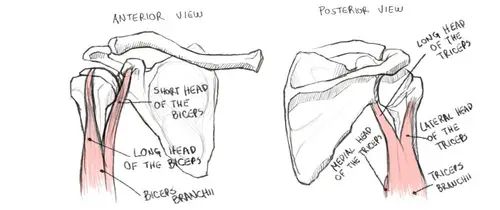
The Biceps and Triceps flex and extend the arm with great force; both muscles originate at the shoulder joint and connect to the forearm.
THE BICEPS
The Biceps Branchii is the main flexor of the arm but also can supinate the forearm.
THE TRICEPS
The Triceps Branchii is the primary extensor of the arm, and also can assist with the lateral adduction of the arm.
TRIVIA
There is a remarkable similarity between chimpanzees and modern humans; the difference lies in slightly different proportions, giving them an upper-body strength advantage. According to Brian Umberger (an expert in musculoskeletal biomechanics in kinesiology at the University of Massachusetts Amherst), pound by pound, the strength of a chimpanzee is about 150% the strength of a human being. Of course, many factors contribute to that difference, including the difference in the ratio of slow-twitch and fast-twitch fibers.
Physics plays a pivotal role in the whole equation; for example, a longer humerus demands more strength to move the same resistance (humans have longer humerus), while a larger scapula or longer sternum, (chimps have larger scapula and sternum) can support larger (stronger) muscles.
All species have evolved differently to adapt to their particular needs.
While chimpanzees excel at upper body strength, humans can take the lead on endurance. For example, no man with an ounce of common sense would challenge a chimpanzee (of the same weight) to arm-wrestling, but even an “average Joe” could beat them on a 3 miles walk.
