Shoulder Stability Training Prevents Pain
Most people don’t think about their shoulders until something goes wrong. Then suddenly reaching for a coffee cup hurts, sleeping on one side becomes impossible, and lifting a grocery bag feels like a project. Shoulder stability training is the answer most people never hear about, because the conversation usually jumps straight to stretching or surgery. Neither is the real fix.
The shoulder is the most mobile joint in the human body. That’s a feature, not a bug. But every feature comes with a cost. The more directions a joint can move in, the more muscles, tendons, and ligaments are needed to keep it stable, and the more things can go wrong when one piece stops doing its job.
Why The Shoulder Breaks Down So Easily
Think of the shoulder like a golf ball sitting on a tee. The ball is the head of your humerus. The tee is a small, shallow socket on your shoulder blade. There’s nothing locking those two pieces together except muscles, tendons, and ligaments working in concert.
Compare that to your hip, where the ball sits deep inside a socket. The hip is built for stability. The shoulder is built for range. That trade-off is what lets you throw a ball, swing a golf club, and reach into the back seat. It’s also why shoulders are the most commonly dislocated joint in the body.
Over the past 20 years, I’ve seen the same pattern again and again. Clients come in complaining about pain, weakness, or that nagging feeling that something just isn’t right. They’ve tried rest. They’ve tried stretching. Some have tried cortisone shots. What they haven’t tried is teaching the small muscles around the joint to actually do their job.
The Cascade Of Calamities
Here’s what nobody tells you about shoulder pain. It’s almost never just the shoulder.
When one stabilizer fails, the body recruits other muscles to pick up the slack. Those muscles weren’t designed for that role, so they tighten, fatigue, and eventually start pulling things out of alignment. The rotator cuff stops centering the joint properly. The shoulder blade starts riding up toward the ear. The neck gets involved. Soon you’ve got pain that feels like it’s everywhere and nowhere at the same time.
Michael came to me last year. He’s 61, played college football, and has stayed reasonably active his whole life. He told me his right shoulder had been “acting up” for about eight months. He couldn’t sleep on that side anymore. Reaching behind his back to pull on a seatbelt sent a sharp twinge down his arm. His doctor offered an MRI and a referral to a surgeon. Michael wasn’t ready for that conversation yet.
We didn’t start with weights. We started with assessment. His rotator cuff wasn’t torn. His shoulder blade wasn’t tracking properly during basic movements, and the small stabilizing muscles between his shoulder blades had essentially gone offline. The big muscles like the trapezius and deltoid were doing all the work, and they were exhausted from carrying a load they were never meant to carry alone.
What Stability Training Actually Looks Like
Forget what you’ve seen on Instagram. Real shoulder stability work is quiet, deliberate, and usually unimpressive to watch. There’s no grunting. The weights are light. The movements are small.
Here’s what we focus on:
Scapular control. Before the arm can move well, the shoulder blade has to move well. Most people have lost this awareness completely. We retrain it through exercises like wall slides, scapular pushups, and prone Y-T-W holds.
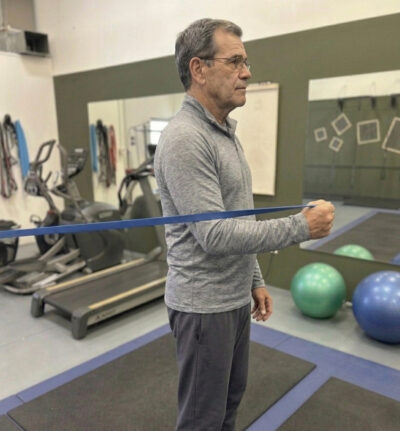
Rotator cuff activation. The four small muscles of the rotator cuff are the unsung heroes of every healthy shoulder. They don’t move the arm so much as they keep the joint centered while bigger muscles do the moving. Banded external rotations and side-lying drills wake them up.
Postural endurance. Your shoulders sit on top of your spine. If your upper back is rounded forward all day at a desk, no amount of shoulder work will fix the problem. Strengthening the muscles that hold you upright is part of the equation.
Loaded carries. Walking with a weight in one hand teaches the entire shoulder complex to stabilize under real-world conditions. It’s one of my favorite exercises for clients dealing with chronic shoulder issues.
After 10 weeks, Michael could sleep on his right side again. The seatbelt twinge was gone. He didn’t need surgery. What he needed was the small muscles to start firing again so the big muscles could stop overworking.
The Mistake Most People Make
When something hurts, the instinct is to either rest it or stretch it. Both are usually wrong for shoulder issues.
Rest doesn’t fix a stability problem. It makes it worse, because the muscles that already weren’t firing get even weaker. Stretching a shoulder that’s already loose because the stabilizers aren’t doing their job is like loosening a screw that’s already stripped. You’re addressing the wrong problem.
So why does this advice persist? Because it’s simple. And because for the first 48 hours of an acute injury, rest is appropriate. But once the initial inflammation has settled, the answer is movement. Specific, controlled, progressive movement that teaches the joint to stabilize itself.
A dear friend who trains with me had been stretching her shoulders religiously for two years to address tightness she couldn’t seem to shake. The tightness was actually her body’s defense mechanism. Her shoulders were unstable, and her muscles were guarding against further injury by tightening up. Once we built strength in the right places, the tightness disappeared on its own. She didn’t need more stretching. She needed her shoulders to feel safe.
Try This: The Wall Angel Test
Stand with your back against a wall. Heels about six inches out, butt and upper back touching the wall. Bring your arms up into a goalpost position with the backs of your hands trying to touch the wall.
Now slowly slide your arms up overhead, keeping the backs of your hands and your forearms in contact with the wall the entire time. Then slide them back down.
Do 10 reps. If you can’t keep your hands on the wall, if your lower back arches up off the wall, or if you feel pinching anywhere in the shoulder, you have a stability and mobility problem worth addressing. Most people fail this test. The good news is it’s also the first exercise toward fixing it.
Who Needs This Work Most
Honestly? Almost everyone over 40 in Carmel, Indiana, and surrounding areas. Desk work, phone scrolling, and golf swings (we have a lot of golfers around here) all conspire to pull the shoulders forward and lock them in patterns they were never designed to hold.
The good news is shoulders respond fast to the right work. Most clients I see for shoulder issues notice meaningful improvement within four to six weeks. Within three months, the change is usually dramatic.
But the catch is this: it has to be the right work. Generic shoulder exercises off YouTube often make things worse, because they don’t address what’s actually weak versus what’s actually tight in your specific body. A good personal trainer assesses first, then programs. That’s the difference between progress and frustration.
Don’t Wait For The Tear
Here’s something I tell every client. The vast majority of rotator cuff tears don’t happen during one dramatic event. They happen because years of poor stability finally caught up to a joint that was begging for help. The tear is the symptom. The instability was the cause.
If your shoulder is talking to you right now, listen. The window for fixing things without surgery is wide open at the early stage. It narrows considerably once tissue actually fails.
At Mobility360.fit in Carmel, Indiana, shoulder stability training is one of the most common reasons people walk through our door. Whether you’re an active 60-year-old who wants to keep playing pickleball, a desk worker tired of waking up stiff, or a former athlete dealing with the consequences of decades of overuse, this work helps. Not as a quick fix. As a real, lasting change in how your shoulder feels and functions.
Reach out for a consultation. Let’s take a look at what’s actually going on, and build a plan that addresses the cause, not just the symptoms. Your shoulders have carried you through a lot. Give them the support they need to keep going.