PART II: THE MUSCLES >
THE AMAZING SHOULDER
PART I: THE BONES
Some people have a good head on their shoulders, need a shoulder to cry or look over their shoulder. Interestingly, the shoulder is a body part that has been part of a great number of phrases. It’s associated with support, stability, strength, and many other positive ideas. Maybe the popularity of the shoulders isn’t a mere coincidence, as they are the most complex joint of the body; Its versatility allows us to pull or push in virtually any direction we please. It’s truly a masterpiece that blends art and engineering.
Besides its wide range of motion, it’s also capable of delivering very impressive amounts of strength.
It allows moving the arm virtually in any direction.
The flexibility of the shoulders varies by each individual in the same way strength does; it can improve with training, but within the scope of each person, not everyone could become as strong as Julius Maddox, or as flexible as Daniel Browning Smith.
PARTS AND PIECES
BONES
Among vertebrates, the bones work as the anchors for the muscles, allowing them to operate while having a solid base and the adequate leverage to execute any action. The design of the bones allows the support of powerful muscles ( as in with the hip bones to support the leg muscles) or delicate ones (as in the case of the wrist, to work with the hand muscles and tendons). However, the bones are also responsible for the way we can, and we cannot move, with slight variations from individual to individual.
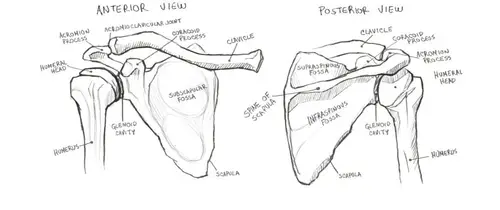
Three bones act directly over the shoulder joint: Clavicle, Humerus, Scapula. But the number increases once we consider the other bone(s) to which each muscle working on those three bones attaches (sternum, spine, and ribs). Thus, in order for a muscle to be able to work, it requires at least two anchor points.
JOINTS
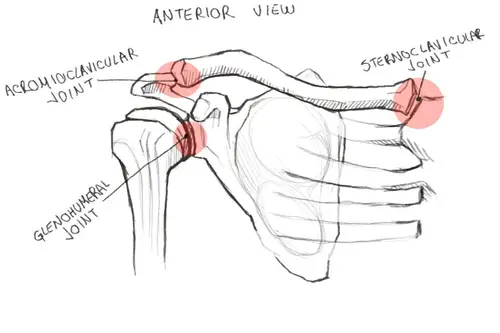
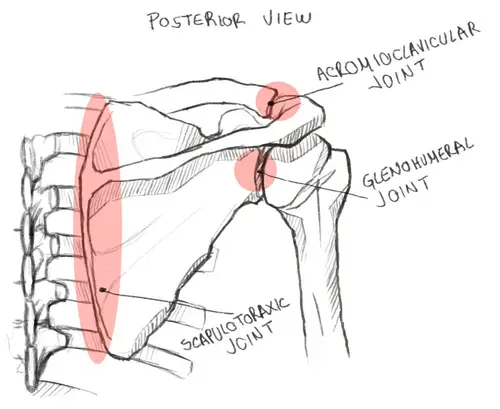
The shoulder relies on four joints to accomplish its range of motion: Sternoclavicular, Scapulotoraxic, Acromioclavicular, and Glenohumeral.
LIGAMENTS
Ligaments are the tissue that connects bones to bones. The ligaments responsible for keeping the humerus, clavicle, and scapula in the proper place are:
The Glenohumeral Ligament(GHL)
This set of ligaments provide the main source of stability to the shoulder and help to keep it from dislocating (a situation in which the humerus jumps out of the glenoid cavity).
The Coracoacromial Ligament(CAL)
It links the acromion to the coracoid. Its potential thickening causes impingement syndrome, a situation in which the space for the muscle responsible for elevating the arm is reduced, causing more friction and, therefore, inflammation and pain.
The Coracoclavicular (CCL)
This set of ligaments link the clavicle and the coracoid process. They are responsible for keeping the shoulders aligned. Despite being extremely strong, a solid impact to the area could tear them, causing the dislocation of the Acromioclavicular joint.
The Transverse Humeral ligament (THL)
It holds the tendon of the long head of the biceps attached to the humerus.

TRIVIA
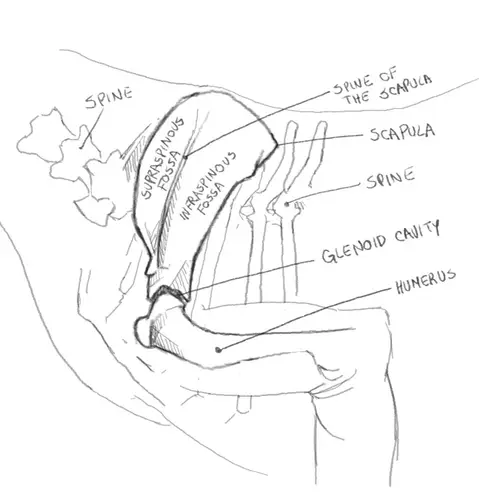
Over millions of years, different species have evolved separately for adaptation. Yet, despite the evident differences, we all are “different versions of the same original model”. The skeleton among vertebrates is nothing else than stretched or squeezed versions of each other. This illustration shows the shoulder structure of a Canis Lupus (specifically an American Pitbull Terrier). The similarities with the human scapula are undeniable, and the differences (in this particular example) give humans the advantage in the range of motion.