Strength Training That Won’t Break You
Strength training that won’t break you starts with one thing most people skip entirely: stability. Not the flashy lifts. Not the heavy plates. The quiet, unglamorous work that teaches your body how to hold itself together before you ask it to do more.
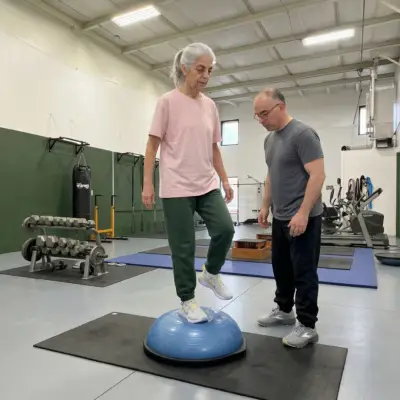
Deborah came to me two years ago after tweaking her lower back picking up a bag of mulch. She wasn’t weak. She walked three miles a day and had been doing group fitness classes for years. But her body didn’t know how to stabilize under load. The muscles that should have braced her spine just… didn’t fire. That’s the gap most people never think about until something goes wrong.
The Difference Between Strong and Stable
Most people think of strength as how much weight you can move. And that’s part of it. But strength without stability is like building a house on sand. You can frame the walls and hang the drywall, but the foundation shifts and everything cracks.
Stability means your joints can hold position while force moves through them. Your shoulder stays locked in place while you press overhead. Your hips don’t shift when you lunge. Your spine stays neutral when you bend to grab something off the floor. These aren’t big, dramatic movements. They’re small corrections happening constantly, driven by muscles most people have never deliberately trained.
So why do so many programs skip this? Because it doesn’t look impressive. Nobody posts a video of themselves doing a slow, controlled single leg balance hold. But that exercise might be the reason they can still deadlift pain free at 60.
What Happens When Stability Breaks Down
Here’s what a typical breakdown looks like. You load up a squat or a press. Your big muscles, the quads, the chest, the shoulders, they do their job and move the weight. But the smaller muscles around your joints can’t keep up. Your knee drifts inward. Your shoulder blade wings out. Your lower back rounds just slightly.
One rep? Probably fine. A hundred reps over six months? That’s where injuries come from. Not from one dramatic moment, but from repeated stress on joints that aren’t properly supported. Research confirms that most non-contact training injuries happen exactly this way, through accumulated strain on unstable joints.
And the risk goes up as we age. After 40, the body loses muscle mass at roughly 3 to 8 percent per decade if you don’t actively fight it. But the loss isn’t evenly distributed. The stabilizing muscles, the ones deep around your hips, shoulders, and spine, tend to weaken faster because daily life doesn’t challenge them enough. You can still walk, sit, and carry groceries. But add resistance training on top of that declining stability base, and something eventually gives.
Why Stability Comes First (Not After)
A lot of training programs treat stability work as an afterthought. A few balance exercises tacked onto the end of a session. Maybe some planks if there’s time. That’s backward.

Stability training should be the foundation you build everything else on. Think of it as teaching your body the rules before you play the game. When your joints are stable, you can actually use your strength safely. Your nervous system trusts the position, recruits muscles more efficiently, and lets you push harder without the emergency brake kicking in.
Tashina had been strength training for about a year when she started working with me. Strong woman. She could leg press serious weight. But a single leg squat? She couldn’t do one without her knee collapsing inward. The strength was there. The stability wasn’t. We spent eight weeks rebuilding her foundation, and the result surprised even her. Not only did the knee pain she’d been ignoring disappear, but her big lifts actually went up. Her body finally had the platform to express the strength it already had.
Building Your Stability Base
Stability training doesn’t require fancy equipment or complicated programming. It requires intention and consistency. Here’s what the foundation looks like:
Single leg work. Standing on one leg while performing movements exposes every imbalance hiding in your hips, ankles, and core. Split squats, single leg Romanian deadlifts, and step ups are staples for good reason.
Anti-movement core training. Forget crunches. Your core’s primary job is to resist movement, not create it. Pallof presses, dead bugs (terrible name, great exercise), and plank variations all train your core to do what it actually needs to do in real life: keep your spine from moving when everything else is.
Controlled tempo. Slowing down your reps, especially the lowering phase, forces your stabilizers to work overtime. A three second descent on a squat is a completely different challenge than dropping fast and bouncing out of the bottom.
Joint specific drills. Shoulder stability exercises like bottoms up kettlebell presses. Hip stability work like banded lateral walks. Ankle stability through single leg balance progressions. Each joint has its own needs.
The Aging Factor Nobody Talks About
After 50, stability training isn’t optional. It’s a requirement. Falls are the leading cause of injury related death in adults over 65. And falls don’t happen because people are weak. They happen because the body can’t react fast enough to recover from an unexpected shift in balance.
Training stability directly improves your body’s ability to catch itself. Your reflexes get sharper. The communication between your brain and your muscles speeds up. The small muscles around your ankles and hips learn to fire before you even consciously register that you’re off balance.
But here’s what doesn’t get said often enough: this kind of training also protects you during your strength workouts. Every time you press, pull, squat, or hinge with a barbell or dumbbell, your stabilizers are working. If they’re undertrained, they fatigue before your prime movers do. And fatigued stabilizers mean sloppy form, compensations, and eventually, injury.
Try This: The Three Point Stability Check
Before your next workout, run through this quick sequence. It takes about five minutes and wakes up the stabilizers you’ll need for everything that follows.
Single leg stance with eyes closed. Stand on one foot, close your eyes, and hold for 30 seconds each side. If you can’t hit 20 seconds without grabbing something, your ankle and hip stability need work. No shame in that. Almost everyone struggles with this at first.
Dead bug with slow tempo. Lie on your back, arms straight up, knees at 90 degrees. Extend your right arm overhead while your left leg extends out, keeping your lower back pressed into the floor. Three seconds out, three seconds back. Five reps each side. If your back arches off the ground, you’ve found the weak link.
Pallof press hold. Using a cable or resistance band at chest height, press both hands straight out in front of you and hold for 15 seconds. The band tries to rotate you. Your job is to resist. Three holds each side. This one lights up stabilizers you didn’t know you had.
Use these as your warm up, not your cooldown. Prime the system before you load it.
What a Stability Focused Program Actually Looks Like
A common mistake is thinking stability training replaces strength training. It doesn’t. It supports it. A well designed program weaves both together.
In practice, that means your training session might start with five to ten minutes of stability and activation work, move into compound strength exercises performed with controlled tempo and full range of motion, and finish with targeted stability challenges for whatever joints took the most stress that day.
Over the years, the clients who stay injury free and keep making progress share one thing in common. They don’t skip the foundation work. They don’t rush past the “boring” stuff to get to the heavy weights. They understand that the ability to lift heavy at 55 or 65 depends entirely on the stability base they build today.
You Don’t Have to Choose Between Strong and Safe
That’s the real message here. Strength training that won’t break you isn’t about going light or avoiding challenge. It’s about being smart with the order of operations. Build stability first. Add strength on top. Keep reinforcing the base as you go.
Your body is designed to be strong well into your later decades. But it needs the right support system. A qualified personal trainer can assess where your stability gaps are and build a program that addresses them before they become problems. That’s exactly what we do at Mobility360.fit in Carmel, Indiana. Not just helping people get stronger, but helping them stay that way. If you’re ready to train with a foundation that lasts, reach out. Your future self will thank you.