What is the Rotator Cuff?
We all have heard someone mentioning the Rotator Cuff. The shoulder is the most mobile joint in the human body: It can rotate and spin, achieving a wide range of motions. The highly intricate structure of the Scapula, Clavicle, and Humerus is mobilized by seven muscles: Coracobrachialis, Deltoid, Teres Major, and “The Rotator Cuff”. The Rotator Cuff is a group formed by four muscles: Supraspinatus, Infraspinatus, Teres Minor, and Subscapularis. (SITS)
Rotator Cuff Injuries
Tears and inflammations are more common among athletes over 40 with a long history of involvement in sports characterized by overhead motion, such as tennis, baseball, basketball, volleyball, and swimming.
Despite being the most common, shoulder injuries are not always related to the Rotator Cuff. There are many muscles that work over the shoulder joint, therefore there are numerous treatments to overcome the combination of possibles injuries.
It is highly advisable to consult your orthopedic at the first sign of a suspected injury since, if caught on time, the situation can be corrected and in that way preserve the health and mobility of the joint.
Scientists being practical
For practical purposes, a number of muscular groups are referred to with a single name. In the Rotator Cuff, The Supraspinatus, the Infraspinatus, the Teres Minor, and the Subscapularis have individualized functions.
understanding the Rotator cuff muscles
Muscles exert their strength while they contract, and relax while they stretch. Along our body, we have a combination of antagonist (opposing efforts) and synergist (joining efforts) muscles. Such characteristic allows all the joints to pull or push, rotate externally or internally, abduct or adduct as we please.
In the shoulder joint, the Teres Minor and the Subscapularis are synergists between them and antagonist to the Subscapularis (and vice-versa).
Seeing and analyzing the shoulder joint is realizing that art and engineering can blend in fantastic ways.
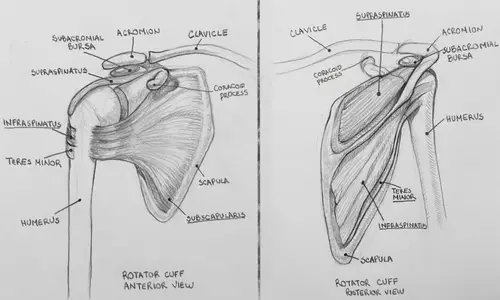
Different muscles for different motions



Adding more to the equation
The Pectoralis Minor, Pectoral Major, and the Latissimus Dorsi also add mobility to the shoulder, by connecting the ribs to the coracoid process of the scapula, the Sternum and Clavicle to the Humerus, and the Spine to the Humerus respectively.
Being able to push, pull, and rotate with significant force, the shoulder joint is a masterfully complex structure.