EXPLOSIVE SPORTS
We all know a great number of sports and activities that includes an explosive motion. A golf drive, tennis shot, baseball throw, and many other actions, rely on acceleration and speed.
What creates such speed and performance among the pros?
Some basic physics achieved by a fascinating combination of skills.
THE GEEKY STUFF
For practicality, let’s focus on one of the sports, but understanding that the basic principles applies to any other activity.
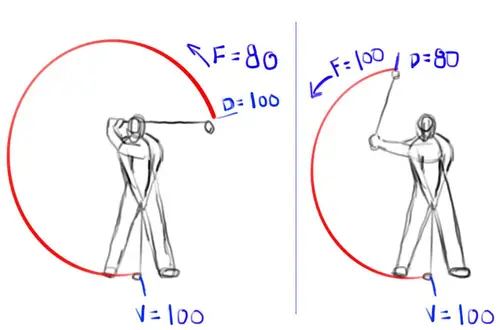
In golf, the longest shot (assuming it’s a straight shot, with impeccable technique) is the one in which the clubhead is traveling at the fastest speed at the moment of making contact with the ball. The clubhead stops at the end of the back-swing and starts gaining speed until the moment of the collision. So far, we already have two evident variables that will determine the final speed: distance and acceleration.
The distance traveled by the clubhead is determined by the flexibility of the golfer, while the acceleration is determined by the force the golfer is able to deliver (strength).
Going back to fundamental physics, the final speed will be equal to the square root of 2 x distance x acceleration, while the acceleration will be the product of the force divided by the mass (the weight of the club, in this case).

In the case of golfer A, playing against golfer B, utilizing the same club, technique, and other conditions, they both will hit the ball at the same speed if golfer A is 20% more flexible, and golfer B is 20% stronger, which explains the importance of strength and flexibility in any sport that requires explosive motion.
THE ELASTIC EFFECT
By observing any creature, it’s easy to realize that there is a milder motion in the opposite direction before any explosive movement. At first glance, it’s similar to the elastic band of a slight-shot going back before shooting, but there is something else. In the case of the sling-shot, the elastic band will gain tension as it gets stretched and will release the tension once the force pulling back gives up. Muscles have another trick up the sleeve, the muscle spindle.
MUSCLE SPINDLE
Muscle spindles are stretch receptors inside the body of a muscle whose job is to detect differences in the tissue’s length. They convey length information and the brain can process this as proprioception. In response, they regulate the contraction of muscles, resisting the stretch, and preventing many injuries due to an overstretch.
The response gets activated due to the amount of stretch in the muscle or the stretching speed.
The muscle spindle requires a fast stretch to trigger an abrupt contraction, also known as the stretch reflex. Many creatures are aware of this reflex and use it to their advantage. If you have ever thrown a ball by performing the “spring back” part of the motion at a very slow speed, you have realized how the strength of the actual throw gets severely compromised.
The faster the stretch, the more abrupt the contraction.
THE BODY WORKING AS A UNIT
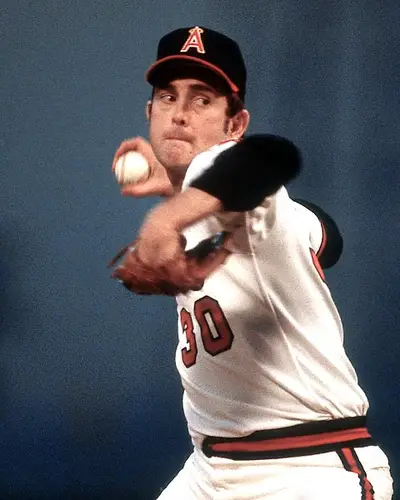
Many Baseball fans agree that Nolan Ryan has one of the strongest arms in the sport history.
On August 20th, 1974, Ryan pitched a ball at 108.4 MPH, but does he actually have the strongest arm?
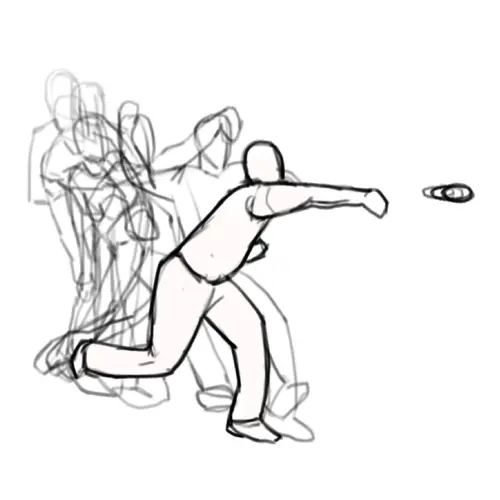
Undoubtedly, Ryan has the fastest recorded pitching in history, but the arm is only a small fraction of the whole equation. It’s a perfectly well-orchestrated movement of the entire body.
The body is designed to work as a unit; sports are clear evidence of it. Virtually every motion includes several joints and a large number of muscles stretching or contracting at any giving time to deliver the best performance.


CONDITIONING AGAINST INJURIES
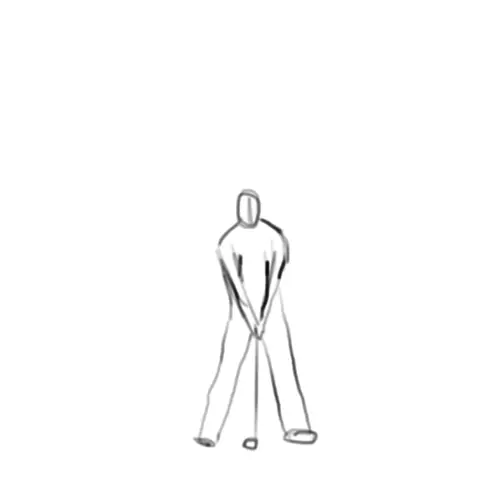
The dream of every amateur is to perform like a pro. To deliver a high power, we require technique, strength, and flexibility. Lack of strength or technique can result in a weak or inaccurate performance, but lack of flexibility can translate easily into injuries.
As the name indicates, professional players do that for a living; it’s not a hobby but a career, which implies hours of training out of the field, simply to condition the body for the high demands of a game.
It’s not uncommon to hear people complaining about injuries after a round of golf, or a friendly game of baseball or tennis. The key is to condition properly, allowing time for proper warm-up and stretch before the game, and being conscious about the physical limitations, to avoid pushing ourselves beyond our own limit.
