MOBILITY
As we age, we start losing some mobility. There is a wide range of reasons for it: from arthritis to lack of activity. It isn’t uncommon for people to start experiencing various aches and discomfort that originate from lack of mobility. Whenever any joint has a limitation in its range, the body will do what the body does best: it will adapt by compensating with other joints to perform any action. That approach is not ideal but will get “the work done”. Unfortunately, the problem just moves to a different area.
RANGE OF MOTION
There is critical importance on maintaining or obtaining the full range of motion of the muscles. The flexibility of each joint is determined by the limits established by the structure of the bones as well as by the muscles that operate the joint.
To explain it with an example, let’s analyze the knee:
Most people can extend the leg to the point where the four ligaments prevent it from advancing any further (straight leg), but a smaller number of people can flex the leg to the point in which the calf makes contact with the hamstrings. What limits this motion is the tightness of the quadriceps.
Remaining in the same subject, runners tend to have tight and strong quadriceps, but not equivalently strong hamstrings, which leads to some knee injuries. That is caused (in part) because running requires a minimal range of motion of the quadriceps.
EXERCISING
Generally speaking, we divide exercises into compound and isolated motions. The norm is that any action that includes only one joint is called an isolated exercise, while the compound exercises require the movement of two or more joints.
Applying the concept to the practice, virtually no exercise works on only one muscle. Although it’s possible to find motions in which only one muscle moves (stretches and contracts), other muscles are needed to maintain the posture. These stabilizing muscles are working “isometrically”, which means no stretching or contracting, but keeping the needed tension.
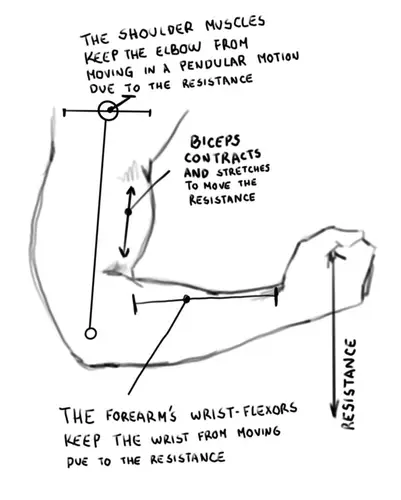
With any resistance training exercise, it’s imperative to identify the primary muscle(s) that perform the motion and check the proper posture to ensure the full range of motion. Undoubtedly, performing an exercise at the full range demands a lighter resistance than if we were limiting the motion. That’s precisely why it’s essential to keep the priorities in check; it’s not about how many repetitions or how much weight we can lift, but about how many or how much we can lift properly.
The great majority of functional motions include several muscles in their executions. Squats are a classic example: The glutes and hamstrings will stretch just so much while we squat; after a certain point (a point that varies depending on the flexibility), the lower back will start stretching to allow the hips to drop even lower (while they tilt forward). Those are important details that play a crucial role in executing an exercise properly.
STRETCHING
Stretching is very important in increasing or preserving mobility. A fit and healthy muscle should have the appropriate balance between strength and flexibility.
Simultaneously, a healthy joint should have balanced antagonist muscles to exert the same tension from both sides, aligning the joint in a neutral position.
AIMING TO THE RIGHT TARGET
It’s not uncommon to see videos of people bragging about doing an unbelievable amount of pushups, pullups, or moving extremely heavy weight. The main purpose of training is not to perform an X amount of repetitions or to lift a determined amount, but to improve the overall performance at any sport, or to build a healthier and fitter body. The only way to achieve those goals is by concentrating the efforts in working to the maximum capacity and utilizing the proper technique.
WORKING ON INDIVIDUAL LIMITATIONS
Naturally, every individual has a different limitation. Some people are able to move a joint to the max of its range, while others will be limited due to injuries, arthritis, scar tissue build-up, muscle tightness, etc. A vital component of a well-structured workout routine is identifying the causes for the lack of mobility and evaluating if the right approach is to work on increasing the range or avoid pushing beyond its current limit, to prevent further injuries.