Strength and Mobility Training Builds Lasting Movement
Strength and mobility training belongs in every workout, yet most people treat them as separate goals. One day they lift heavy. Another day they stretch on a mat. The disconnect between these two qualities explains why so many adults over 40 feel strong in the gym but stiff getting out of a car. When you train strength through full ranges of motion, you build muscles that are not only powerful but also capable of moving freely. That combination changes the way your body performs every task, from carrying groceries up the stairs to playing a round of golf at Plum Creek.
A 2025 randomized controlled trial published in the Journal of Strength and Conditioning Research found that combining resistance training with balance and mobility work produced greater functional improvements than resistance training alone in adults aged 60 to 74. The combined group showed significant gains in dynamic balance, walking speed, and overall physical function. Those results confirm what good personal trainers have understood for years: strength without mobility creates compensation, and mobility without strength creates instability. The goal is to build both at the same time, in the same movements.
Why Separating Strength From Mobility Fails
The traditional approach to fitness draws a hard line between strength work and flexibility work. You do your squats and presses, then you cool down with a few stretches. That separation creates a problem. The strength you build in a limited range of motion does not transfer well to real life, where your body needs to produce force at various joint angles while controlling movement in multiple directions.
Think about picking up a heavy box from the floor. That task requires hip and ankle mobility to get low enough, core stability to protect the spine, and leg strength to stand back up. If you only train squats to a partial depth because your ankles and hips are tight, you never develop the capacity to handle that real world demand safely. A client of mine, David, came to the studio after years of traditional gym training. He could leg press an impressive amount of weight, but he could not squat below parallel without his heels lifting off the ground. His strength existed only within a narrow window. Outside of that window, his body had no idea what to do.
A 2024 systematic review on mobility training in sporting populations found that structured mobility interventions improved or maintained performance measures including strength, balance, speed, and agility. Importantly, the research showed that mobility work did not negatively impact strength performance, dismantling the old myth that stretching makes you weaker. The key is integrating mobility into your strength training rather than treating it as an afterthought.
How Strength and Mobility Training Work Together
The body does not recognize the artificial categories we assign to exercise. Every time you perform a movement, your nervous system coordinates strength, stability, and range of motion simultaneously. Strength and mobility training acknowledges this reality by challenging muscles through their complete available range.
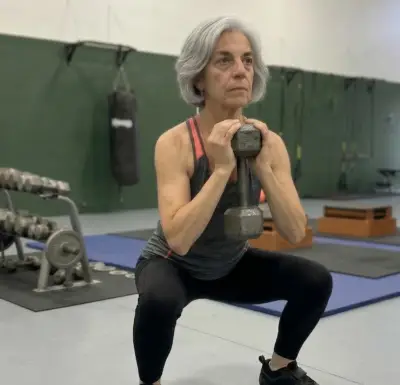
When you perform a deep goblet squat with a controlled tempo, you are strengthening the quadriceps, glutes, and core while simultaneously challenging hip, knee, and ankle mobility. When you execute a Turkish get up, you build shoulder stability through multiple planes of movement while demanding thoracic spine rotation and hip flexibility. These are not mobility exercises with weight added on top. They are strength exercises performed through movement ranges that develop both qualities at once.
Research published in 2025 examining functional resistance training versus traditional resistance training found that both approaches produced comparable strength gains. However, only the functional training groups showed significant improvements in movement quality scores. Even more revealing, the traditional training group experienced a decline in movement efficiency over time. Strength training that ignores movement quality can actually make you move worse, even as the numbers on the bar go up.
The Full Range Strength Advantage
A large meta analysis demonstrated that resistance training performed through full ranges of motion significantly increases joint range of motion, often matching the gains achieved through traditional stretching programs. That finding reshapes the entire conversation about flexibility. You do not necessarily need a separate stretching routine if your strength training addresses full ranges of motion consistently.
This matters enormously for the professionals who train at Mobility360.fit. Spending an extra 30 minutes stretching after a workout is not realistic for most busy adults. But performing your strength exercises through complete ranges of motion accomplishes both goals within the same training session. A Romanian deadlift taken to a full hamstring stretch under load develops more functional flexibility than a passive hamstring stretch held for 30 seconds. The loaded position teaches the nervous system that the end range is safe and that the muscles can produce force there.
Margaret, a client in her early 50s, had been stretching her hamstrings religiously for years with minimal results. Within eight weeks of incorporating loaded stretching through exercises like deep split squats and slow eccentric Romanian deadlifts, she gained more hip mobility than she had in the previous two years of static stretching alone. The difference was that her nervous system learned to trust those new ranges because strength was present there.
Building Your Strength and Mobility Foundation
A well designed strength and mobility training program does not look dramatically different from a solid functional training program. The distinction lies in the intention behind every repetition. Each exercise should challenge both strength and range of motion rather than sacrificing one for the other.
The foundation starts with movement quality. Before adding load, each pattern needs to move through a full, controlled range. A squat should reach a depth where the hip crease drops below the knee. A press should achieve full overhead extension. A hinge should produce a complete stretch through the posterior chain. Once that range is established with control, progressive resistance reinforces and deepens those patterns.
Tempo manipulation plays a critical role. Slowing down the lowering phase of an exercise to three or four seconds forces the muscles to work through every degree of the range under tension. That approach builds strength at the ranges where most people are weakest, which are typically the deepest positions. A slow, controlled descent into the bottom of a squat builds both the mobility to get there and the strength to get back out.
Try This: The Loaded Hip Mobility Sequence
This sequence combines strength and mobility in a single flow. Perform it as a warm up or as part of your main training session.
Start with a deep goblet squat hold. Hold a kettlebell or dumbbell at your chest. Sink into the deepest squat you can manage with your heels flat on the ground. Hold for 20 seconds, using your elbows to gently press your knees outward. Then stand up and immediately perform five slow goblet squats with a three second descent and a one second pause at the bottom.
Next, step into a deep reverse lunge. Lower your back knee to just above the ground while keeping your torso upright. Hold the bottom position for three seconds, feeling the stretch through the hip flexor of the trailing leg. Perform five repetitions on each side with the same weight you used for the squats.
Finish with five single leg Romanian deadlifts on each side, lowering the weight as far as your hamstring flexibility allows while keeping a flat back. The goal is to reach a deeper range each week while maintaining control throughout the movement.
This sequence takes less than ten minutes and addresses hip, ankle, and hamstring mobility while building meaningful strength through the legs, glutes, and core. It is exactly the kind of work that closes the gap between gym strength and real world capability.
Programming Strength and Mobility for Long Term Results
The most effective strength and mobility training programs follow a progressive structure. During the first four weeks, the emphasis falls on establishing full range movement patterns with light to moderate loads. Weeks five through eight increase the resistance while maintaining depth and control. From week nine forward, the focus shifts to building strength at end ranges through methods like pause repetitions, slow eccentrics, and loaded stretches.
A personal trainer who understands the relationship between strength and mobility can identify where your specific limitations lie. Some people have adequate hip mobility but lack shoulder range. Others have flexible hamstrings but stiff thoracic spines. Over the past 20 years, I have seen that the most efficient path forward depends entirely on the individual assessment. Cookie cutter programs miss the compensations that make each person unique.
Recovery plays a role as well. Training strength through full ranges of motion creates greater muscle tissue adaptation because the muscles are working under tension at longer lengths. That means recovery demands increase. Adequate sleep, proper hydration, and sufficient protein intake all support the tissue remodeling that makes strength and mobility gains stick. Research from a 2025 study in the Journal of Nutrition, Health and Aging confirmed that combining resistance training with balanced nutrition produced the strongest and broadest benefits for muscle strength, gait speed, and functional health.
Moving Forward With Confidence
Strength and mobility training represents the most practical approach to building a body that performs well beyond the walls of a gym. It does not require exotic equipment or complicated programming. It requires attention to movement quality, patience with progression, and the discipline to prioritize range of motion alongside resistance.
The body is designed to work as a unit. Muscles do not operate in isolation, and the qualities of strength and mobility are not separate currencies that need different bank accounts. They belong together in every training session, every exercise, and every repetition. Whether you are recovering from an injury, preparing for a sport season, or simply wanting to move through your daily life without stiffness and discomfort, the integration of strength and mobility delivers results that last.
At Mobility360.fit in Carmel, Indiana, every training session is built around this principle. If you are ready to experience what strength and mobility training can do for you, the next step is a conversation about where you are and where you want to go.